Dans le paysage numérique en rapide évolution de 2026, la page de résultats des moteurs de recherche traditionnels n'est plus la destination finale de la plupart des utilisateurs. Alors que les habitudes des utilisateurs se tournent vers des interfaces conversationnelles telles que ChatGPT, Claude et Google Gemini, une nouvelle discipline émerge à l'intersection de la technologie et du marketing : Optimisation LLM (LLMO).
Pendant des décennies, les entreprises se sont concentrées sur le classement dans une liste de liens ; aujourd'hui, l'objectif est d'être la source principale citée dans une réponse synthétisée par IA.
🎯La réalité du clic zéro 🔮
Les données indiquent qu'à la fin de 2026, les assistants IA géreront près de 25 % de toutes les requêtes de recherche mondiales. Cette évolution a créé une réalité de "zéro clic" où l'information est consommée sans qu'un utilisateur n'ait jamais à visiter un site Web.
Changement Critique : Les marques doivent aller au-delà du bourrage de mots-clés traditionnel et apprendre à optimiser leur contenu pour les grands modèles linguistiques afin de survivre à cette transition.
Pour survivre à cette transition, les marques doivent aller au-delà du bourrage de mots-clés traditionnel et apprendre à optimiser leur contenu pour les grands modèles linguistiques.
Comprendre le cœur : Qu'est-ce que l'optimisation LLM ?
Optimisation LLM (LLMO)—souvent appelé SEO IA ou Optimisation du Moteur Génératif (GEO)—est le processus stratégique visant à rendre une marque, un produit ou un contenu facilement découvrable, interprétable et citable par les grands modèles linguistiques.
💡Autorité sans encombre 💡
Au cœur de l'optimisation LLM, il s'agit de autorité sans encombre. Ces modèles ne recherchent pas simplement le plus de backlinks ; ils privilégient les informations claires, bien structurées et factuelles qui apportent une valeur directe à la requête de l'utilisateur.
Avis critique : Si un modèle ne peut pas analyser facilement ce que vous faites ou pourquoi c'est important, votre marque disparaît effectivement du parcours d'achat piloté par l'IA. Le passage s'effectue de "l'écriture pour les clics" à "l'écriture pour l'ingestion".
Pour les spécialistes du marketing, cela signifie passer de "l'écriture pour les clics" à "l'écriture pour l'ingestion". Si un modèle ne peut pas analyser facilement ce que vous faites ou pourquoi c'est important, votre marque disparaît effectivement du parcours d'achat piloté par l'IA.
Comment l'optimisation LLM diffère du SEO traditionnel
Pour mettre en œuvre une stratégie LLMO réussie, vous devez comprendre comment les "règles de visibilité" ont changé. Dans la recherche traditionnelle, vous étiez en concurrence avec d'autres pages Web pour une position plus élevée dans une page de résultats. À l'ère des grands modèles linguistiques, vous êtes en concurrence pour être le vérité faisant autorité que l'IA utilise pour construire sa réponse.
L'optimisation LLM nécessite un passage à la recherche "basée sur les entités". Plutôt que de suivre des mots-clés individuels, les modèles analysent les relations entre les "entités" — personnes, lieux, choses et concepts.
Par exemple, si votre contenu définit clairement un terme sectoriel complexe et fournit un point de données unique, le modèle vous identifie comme une autorité sur cette "entité" spécifique. Ce passage des "chaînes de caractères" aux "choses" est le pilier fondamental de la visibilité moderne.
Vous pouvez commencer à évaluer vos niveaux d'autorité actuels en utilisant le MultiLipi Outil d'audit SEO gratuit.
Les piliers stratégiques de l'optimisation LLM
L'optimisation pour les grands modèles linguistiques nécessite une approche multicouche combinant la structure technique avec une autorité thématique approfondie.
Structure pour la parsabilité
Les grands modèles de langage parcourent le contenu presque comme un humain pressé. Ils privilégient les formats structurés et faciles à assimiler, tels que les puces, les listes numérotées et les résumés concis.
Pour optimiser votre contenu, assurez-vous que chaque page commence par une réponse directe à la question principale qu'elle aborde. Cette méthodologie « Réponse d'abord » permet à une IA d'extraire et de citer votre contenu beaucoup plus facilement.
Clarté sémantique et richesse des entités
Les modèles d'IA prospèrent grâce à un langage clair et littéral. Pour minimiser les "malentendus de l'IA", les marques devraient privilégier les descriptions simples plutôt que le jargon de marque ou les métaphores.
Lorsqu'un LLM ne parvient pas à analyser le sens de fond de vos termes de recherche, votre marque perd son avantage de citation. Approfondir votre contenu avec des sous-thèmes pertinents et des concepts connexes — un processus connu sous le nom de construction de « profondeur thématique » — est essentiel pour gagner la confiance de l'IA.
Performance technique et accessibilité
Bien que les LLM ne soient pas des utilisateurs en soi, les robots d'indexation qui les alimentent sont sensibles à la santé du site. Une architecture de site propre, des hiérarchies logiques et l'absence de blocage agressif des robots sont des conditions préalables à l'optimisation pour les LLM.
De plus, comme la plupart des recherches alimentées par l'IA se font sur mobile, il est impératif de s'assurer que votre site est entièrement réactif et se charge rapidement.
Des outils comme MultiLipi aide à automatiser ces piliers stratégiques dans plus de 120 langues, garantissant que votre contenu conserve une cohérence structurelle et une clarté sémantique sur chaque marché.
Comparaison : SEO vs. GEO vs. LLMO
Comprendre la terminologie est la première étape pour décider où allouer votre budget marketing.
| Fonctionnalité | SEO traditionnel | GEO | LLMO |
|---|---|---|---|
| Objectif principal | Liens classés et trafic organique | Inclusion dans les résumés IA | Visibilité dans l'IA conversationnelle |
| Métrique de succès | Taux de clics (CTR) | Fréquence des citations par IA | Précision des mentions de marque |
| Plateforme cible | SERP Google, Bing | Aperçus IA, Perplexité | ChatGPT, Claude, Gemini |
| Focus Tactique | Mots-clés et backlinks | E-E-A-T et sources | Clarté des entités et profondeur sémantique |
| Style de sortie | Liste des résultats | Réponse résumée | Recommandation conversationnelle |
Le défi de l'optimisation multilingue des LLM
L'optimisation LLM devient exponentiellement plus complexe lorsque votre public est mondial. Les modèles d'IA présentent souvent un "biais d'autorité" envers les sources linguistiques dominantes, comme l'anglais, car elles disposent d'un plus grand volume de données d'entraînement dans ces langues.
Pour les marques internationales, cela signifie que votre contenu en anglais pourrait être utilisé pour répondre à une requête en espagnol ou en hindi sans que le modèle ne cite jamais votre page localisée. Cette « cannibalisation interlinguistique » constitue une menace majeure pour le trafic mondial.
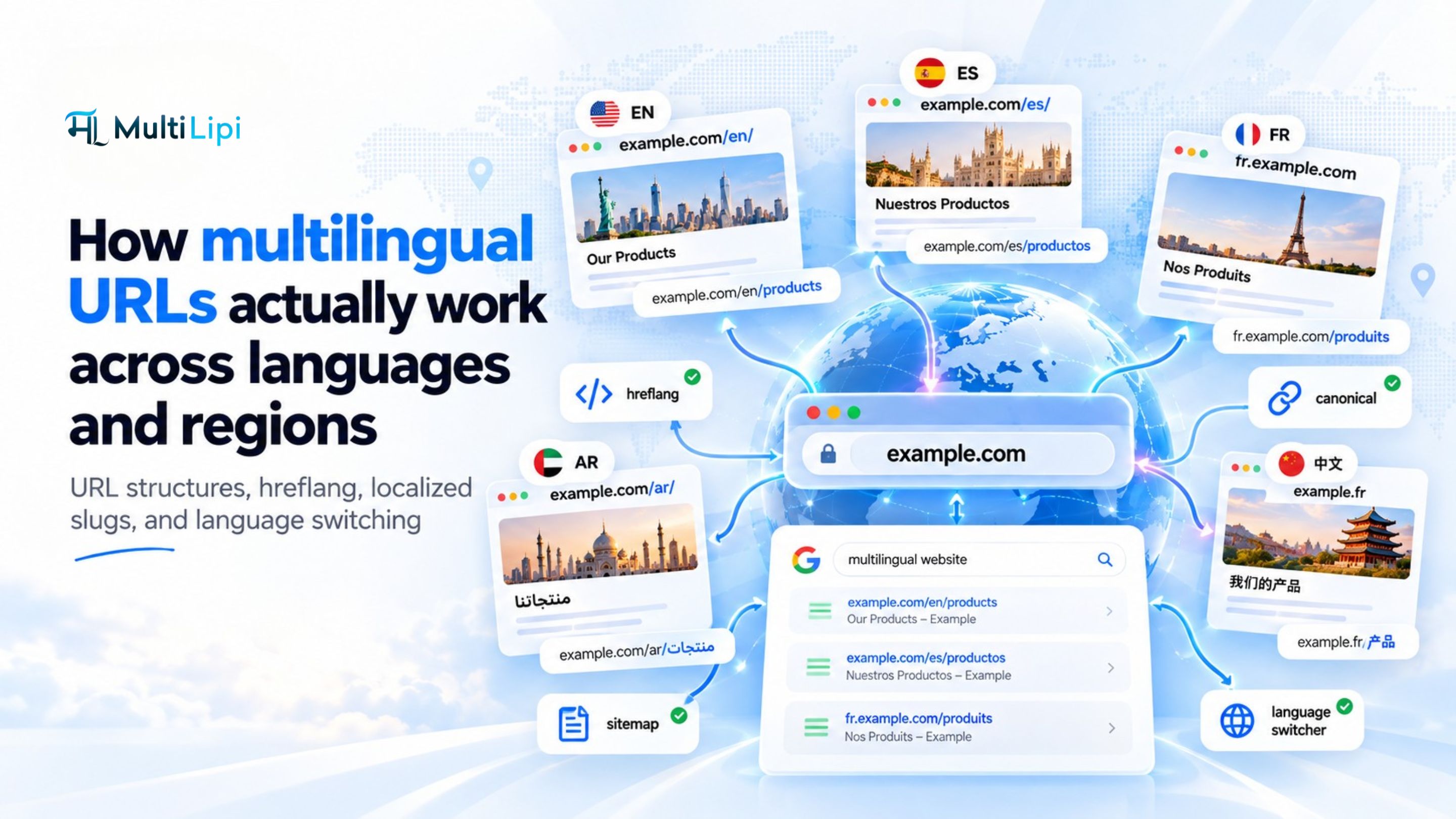
Pour combattre cela, les entreprises doivent construire E-E-A-T localisé. En utilisant MultiLipi pour garantir vos fondations techniques telles que balises hreflang et schéma traduit sont sans faille, vous donnez à l'IA la confiance nécessaire pour citer votre version locale plutôt que de traduire automatiquement votre site en anglais.
Il est essentiel de maintenir une entité de marque cohérente à travers les langues. Si votre marque est mal interprétée dans une langue, cette erreur peut rapidement être amplifiée dans l'ensemble du graphe de connaissances mondial de l'IA.
Pour estimer le volume de contenu que vous devez protéger sur chaque marché, commencez par le MultiLipi Outil de comptage de mots.
Conclusion : La transition vers une visibilité centrée sur l'IA
L'ère où l'on ne comptait que sur les "liens bleus" est révolue. Que vous l'appeliez Optimisation LLM ou GEO, la mission reste la même : assurer que votre marque soit représentée avec précision et fréquence dans les réponses que l'IA fournit à vos clients.
En priorisant la clarté des entités, le contenu axé sur les réponses et la santé technique du site, vous pouvez pérenniser votre visibilité face à la tendance du « zéro clic ».
Comme démontré par notre Études de cas multilingues, les marques qui passent des tactiques de mots-clés traditionnelles à l'optimisation localisée pour l'IA constatent des augmentations significatives de leur autorité et de leurs conversions.
Par exemple, Hotel Continentale a atteint un augmentation de 120 % dans le trafic simplement en s'assurant que leur contenu était correctement structuré pour les robots d'exploration IA internationaux.
L'avenir de la recherche ne consiste plus seulement à être trouvé ; il s'agit d'être compris par les modèles qui guident désormais les décisions des consommateurs.