Le guide du débutant pour la localisation de sites Web : plus qu’une simple traduction
 MultiLipi
•
15 sept. 2025
•
10 min de lecture
MultiLipi
•
15 sept. 2025
•
10 min de lecture
Website localization is more than a word-for-word conversion – it’s about creating a native experience for every audience.De grandes marques mondiales comme McDonald’s, Netflix et Spotify ont appris que la simple traduction de texte ne suffit pas à séduire les utilisateurs internationaux. En fait, les recherches montrent que 76% of online shoppers prefer to buy products with information in their own language, and 40% won’t buy from websites in other languages[Recherche] . La traduction brise la barrière de la langue, mais localisation va plus loin en adaptant le contenu à la culture et au contexte du marché cible. Ce guide explique les principales différences entre la traduction et la localisation, et pourquoi une véritable localisation est cruciale pour le succès mondial.
What Is Website Translation?
Website traduction is the process of converting the text on your site from one language to another while preserving its original meaning. The goal is straightforward: make your content understandable to speakers of a different language. This typically involves translating page copy, menus, product descriptions, and other textual elements into the target language[MultiLipi] . La traduction met l’accent sur l’exactitude linguistique, par exemple en s’assurant que la traduction est dans un ton linguistique. « Bonjour, tout le monde ! » in English it becomes « ¡Hola, mundo ! » in Spanish with the same intent. Modern tools and AI-driven machine translation can accelerate this process, enabling even small businesses to add multiple languages quickly. However, translation seul often stops at the literal level. It closes the language gap, but ne tient pas compte des nuances culturelles ou des attentes de l’utilisateur dans la région cible . A purely translated site may have correct grammar and vocabulary, yet still feel “foreign” to local users if nothing else is adapted beyond the words.
What Is Website Localization?
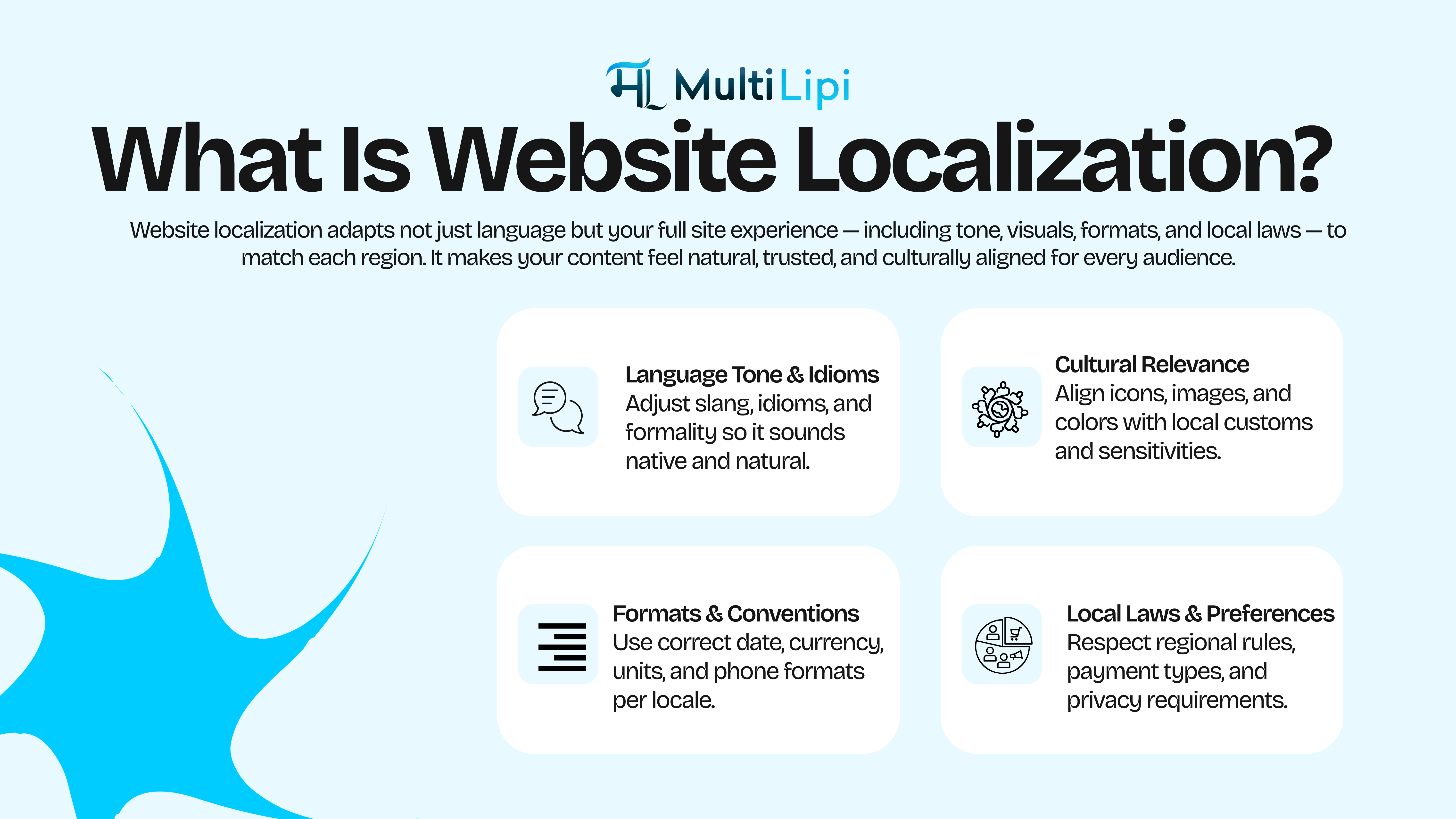
Website localisation va bien au-delà de l’échange de texte de la langue A à la langue B. Localization is not just translation – it’s about adapting your website’s content, design, and user experience to resonate with local audiences[localisation] . Après la traduction du texte, la localisation affine l’ensemble pour répondre aux attentes linguistiques, culturelles et fonctionnelles du marché cible. En bref, là où la traduction véhicule du sens, la localisation transmet Signification de l’ensemble de l’expérience.
To truly “localize” a site, you might need to adjust:
- Ton de la langue et expressions idiomatiques : Use vocabulary, slang, formality level, and idioms that feel natural to native speakers. A phrase can be technically translated correctly but still sound awkward or too formal to locals. Localization refines wording so it “sounds right” to the target audience (often by involving native translators or in-country reviewers).
- Références culturelles et imagerie : Assurez-vous que les graphiques, les icônes, les couleurs et les symboles sont appropriés à la culture. Par exemple, le rouge est une couleur porte-bonheur en Chine mais signifie le deuil en Afrique du Sud , de sorte que la palette de couleurs d’un design peut changer pour chaque région. Les photos ou les exemples peuvent être échangés pour éviter de dérouter ou d’aliéner les utilisateurs - les visuels et les références doivent refléter les coutumes, les fêtes et les valeurs locales.
- Formatage et conventions locales : Adaptez des détails pratiques tels que date/time formats, currencies, numbers, addresses, and units of measurement to local norms. A localized site displays prices in the local currency (e.g. euros for Europe), uses the local date format (e.g. DD/MM/YYYY in the UK), shows telephone numbers with the correct country code and format, etc. These small tweaks greatly increase user comfort and trust.
- Réglementations et préférences locales : Account for local laws (privacy notices, cookie consent requirements in the EU, etc.), preferred payment methods, shipping options, and other regional expectations. For instance, an e-commerce site in India might integrate popular local digital wallets, and a US site might emphasize credit cards. Proper localization ensures you’re not just linguistically correct but also legally and practically ready for each market.
Essentiellement La localisation est un processus complet that encompasses linguistic nuance, cultural context, and regional usability preferences, whereas simple translation does not. A fully localized website should feel as if it were created within the target country in the first place. When done right, users browsing a localized site feel instantly at home – they may not even realize the site originated elsewhere, because nothing feels “lost in translation”[Comparaison] .
Traduction ou localisation : principales différences
Pour clarifier la distinction, voici un résumé de la façon dont la traduction de base diffère de la localisation complète :
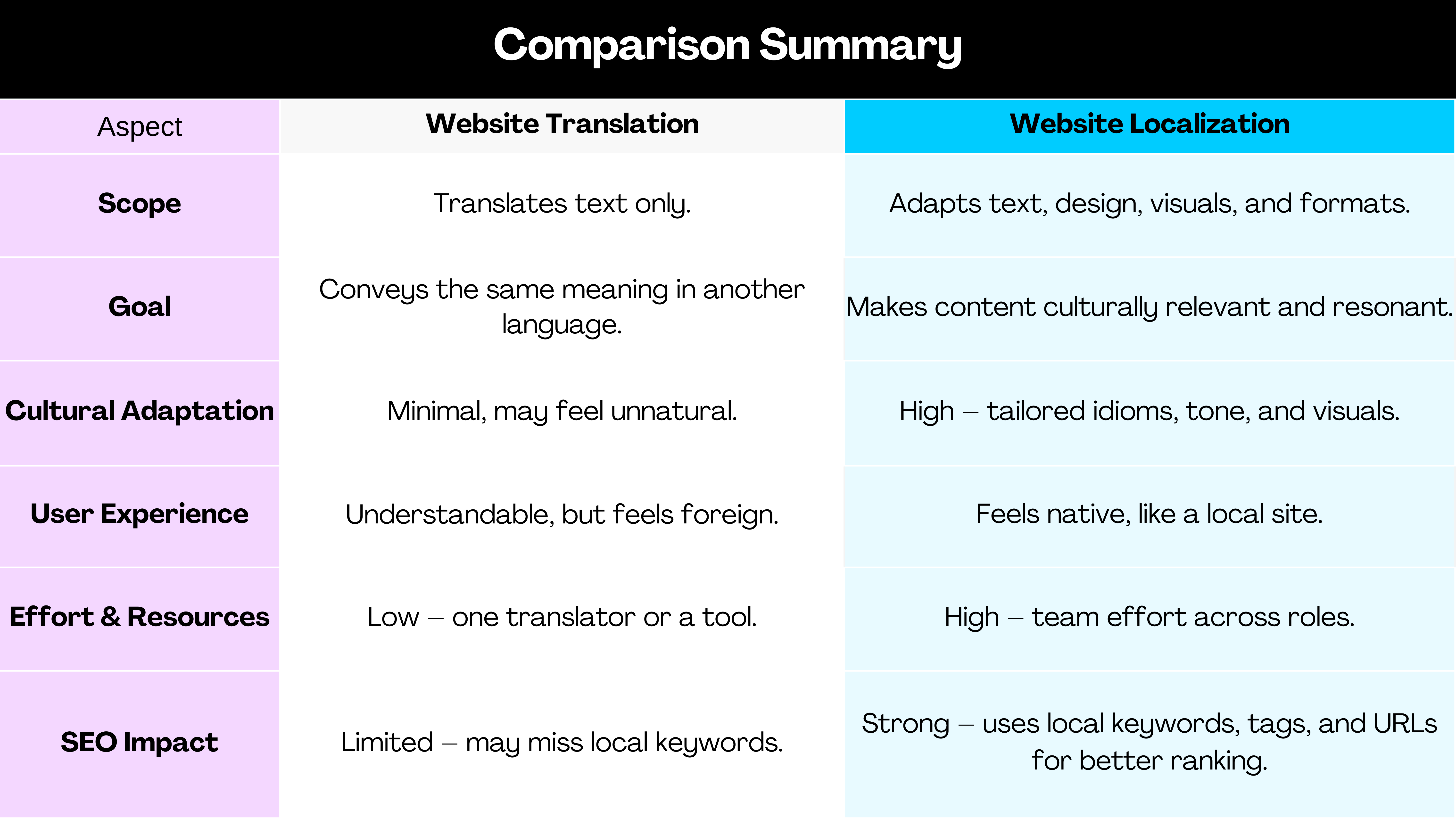
Pourquoi ces différences sont-elles importantes ? A translated website is a good first step to reach new users, but La localisation est souvent la différence entre l’utilisateur compréhension your site versus trulyengageant with it. A merely translated site might be linguistically correct yet still not feel trustworthy or relevant, whereas a localized site builds immediate familiarity and trust.
Pourquoi la localisation (et pas seulement la traduction) est importante
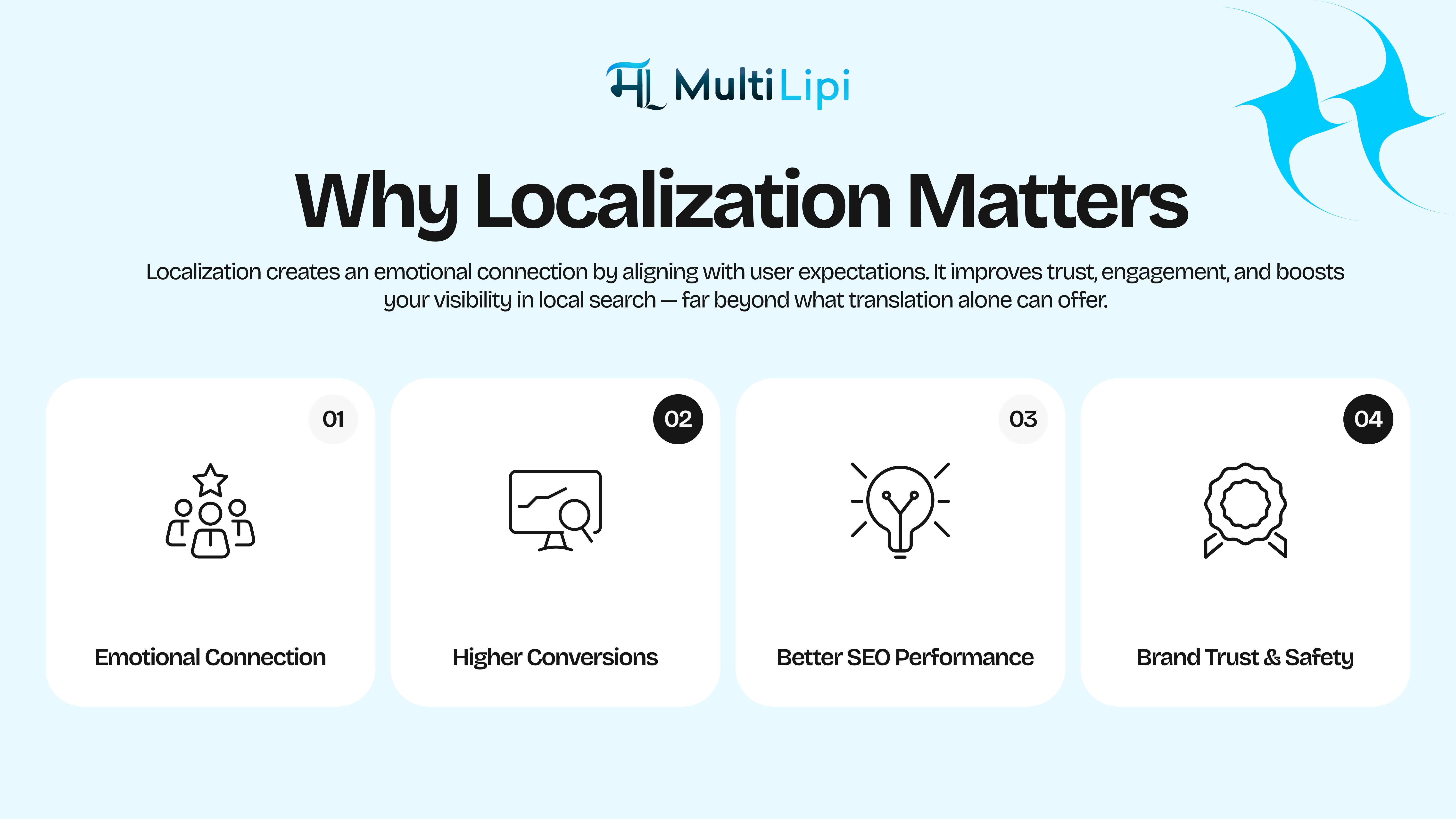
Investing in full localization can make or break your success in a new market. Today’s users expect a seamless, native experience – they want to feel like your website “gets” them. If your site is only translated, it may be readable but could still feel like a foreign import. Visitors might be put off by odd turns of phrase, unfamiliar cultural references, or interface elements that clearly weren’t designed for them. In contrast, a localized site signals respect and understanding: it shows you’ve made an effort to speak leur Langue et align with leur culture. Cela crée un lien émotionnel qui peut considérablement augmenter les taux de conversion, la satisfaction des clients et la fidélité à la marque.
Il y a une clarté Analyse de rentabilisation d’aller au-delà de la traduction. Selon une vaste enquête menée par CSA Research, les entreprises qui ne localisent pas correctement leur contenu risquent de perdre 40 % ou plus de clients potentiels [recherche] . Imagine nearly half of your audience bouncing away because your site doesn’t fully cater to their language or local expectations. On the flip side, providing a well-localized experience can unlock huge growth opportunities. Users spend twice as long on websites in their own language and are far more likely to make a purchase[Guide SEO] . They also tend to return more often. One study found 65% of consumers prefer content in their native tongue, even if it’s of lower quality, rather than consuming content in another language[1]. In short, people feel most comfortable buying from sites that parler leur langue – literally and culturally.
La localisation améliore également votre SEO and discoverability abroad. Simply translating your site into, say, Spanish doesn’t guarantee Spanish-speaking users will find it. If you don’t localize your SEO – such as using the search terms Habitants réels use, or adding region-specific tags – your translated pages might not even show up prominently on Google. Proper localization entails doing multilingual keyword research and implementing technical SEO best practices for each language (unique URLs, hreflang tags, localized metadata, etc.). Localized sites thus tend to rank higher in local search results, bringing in more organic traffic. For example, a localized Spanish site will likely use Spanish-friendly URLs (/es/ or a country domain) and target colloquial Spanish keywords, making it far more visible on Google.es than a direct translation stuffed with literal terms. Localization helps ensure the content et the way it’s presented are optimized for each market.
Enfin, la localisation protège et valorise votre Réputation de la marque . By respecting cultural differences, you avoid embarrassing mistranslations or cultural faux pas that can damage your credibility. L’histoire est pleine de mises en garde : for instance, Parker Pen infamously mistranslated its slogan “It won’t leak in your pocket and embarrass you” for a Latin American market, ending up with a phrase that suggested it would imprégner you – a blunder that went viral for the wrong reasons. Such mistakes are a risk if you rely on literal translation without cultural review. Proper localization includes in-context QA checks to prevent these gaffes. On the positive side, when customers see their language and culture reflected correctly on your site, it sends a message: Nous nous soucions de vous . That boosts your brand image and trust. People are more likely to engage with and buy from a brand that speaks to them in a familiar way.
Conclusion: La traduction permet à votre contenu de franchir, mais La localisation permet à l’utilisateur de se sentir chez lui une fois qu’il est à l’intérieur . It’s often the decisive factor in whether international visitors merely understand your site or truly connect with it.
Exemples de localisation en action
Pour illustrer le fonctionnement d’une localisation complète, voyons comment certaines marques mondiales bien connues vont au-delà de la traduction de base pour adapter leurs offres aux marchés locaux :
McDonald’s : adapter les menus aux goûts locaux
Le hamburger McAloo Tikki en Inde est un exemple de menu localisé de McDonald’s, avec un hamburger de galette de pomme de terre créé pour les préférences végétariennes locales. McDonald’s is a prime example of “thinking global, acting local” with its menu. The fast-food giant maintains its core brand everywhere but modifies its menu items to fit local cultures. In India – where a large portion of the population is vegetarian and beef is widely avoided – McDonald’s replaced beef patties with chicken in its signature burger (the Big Mac) and rebranded it the « Maharaja Mac. » It also introduced unique vegetarian options like the Burger McAloo Tikki , made with spiced potato, which isn’t found anywhere else in the world[recherche interne] . Additionally, Indian outlets serve items like the McSpicy Paneer (a fried cottage-cheese patty) to cater to local tastes[28]. Ces changements vont au-delà de la traduction : il s’agit de localisations de produits et de marketing dictées par des normes culturelles et religieuses. De même, McDonald’s dans les pays du Moyen-Orient propose un McArabia (a flatbread sandwich) and ensures all meat is halal, aligning with local dietary laws. In Japan, seasonal items like a Thé vert McFlurry apparaissent dans le menu [MultiLipi] . By localizing its food and even its advertising (e.g. adjusting slogans and imagery), McDonald’s makes customers around the world feel like the brand is a part of leur la culture locale, pas une influence extérieure.
Netflix : Plateforme mondiale, contenu local
Netflix’s streaming service succeeds globally in large part due to localization. The Netflix interface is available in over 60 languages, but more importantly, Netflix heavily localizes its Contenu et expérience utilisateur . This goes beyond translating show titles and subtitles (which Netflix ensures are high-quality and culturally sensitive). Netflix invests in producing émissions et films originaux dans de nombreux pays , using local languages, actors, and storylines that resonate with regional audiences[Étude de cas] . For example, it developed hits like « Lupin » en France, « La Casa de Papel » (La Casa de Papel) en Espagne, et « Jeux sacrés » en Inde – contenu créé par et pour those local markets, which it then successfully exported worldwide. Netflix also adapts its marketing and recommendations per locale. It curates different cover art and suggestions based on a user’s language and region, knowing that visual preferences vary. In one localization initiative, Netflix found that even the Images promotionnelles pour la même émission étaient plus efficaces lorsqu’elles étaient adaptées à différents publics - de sorte que les vignettes que vous voyez peuvent varier selon le pays ou l’histoire de visionnage, mettant en évidence des personnages ou des thèmes qui font plus appel à la culture de ce spectateur. Par Personnalisation both content and presentation (even the genre categories and search algorithms) to each market, Netflix ensures that viewers in Japan, Brazil, or Germany feel the platform was made for them. The result: stronger engagement and subscriber growth in each region, all while maintaining a cohesive global brand.
Spotify : Personnaliser l’expérience musicale localement
Spotify, the music streaming leader, has grown to over 180 markets by embracing the mantra “Think Global, Act Local.” Spotify localizes not just its app’s language, but also its features, content, and payment options. The interface utilisateur is translated into dozens of languages, and Spotify accepts region-specific payment methods (for instance, enabling mobile wallet payments or local bank cards in countries where credit card usage is low) to make subscribing easier[Spotify] . Culturally, Spotify goes further: it curates listes de lecture de musique populaire au niveau régional and spotlights local artists in each market. When Spotify launched in India, for example, it organized playlists like “Sound of Mumbai” to reflect what people in different Indian cities were listening to. It even added an in-app Mode karaoké au Japon after discovering Japanese users expected that feature in a music service. These are not translations at all, but product changes informed by local user research. Spotify’s marketing campaigns are also localized – featuring local musicians and cultural references – rather than using a one-size global ad. By adapting to local music tastes and user habits (from interface design to content library and features), Spotify makes users around the world feel a sense of belonging on the platform. One former Spotify executive noted that localization is more important in music streaming than in many other industries, which is why Spotify maintains strong regional teams to tailor the experience country by country. The payoff has been dramatic: Spotify scaled up in far more countries than its competitors (e.g. Amazon Music) by understanding and serving local needs, not just translating its app[Stptrans] .

Conclusion
Entering new markets requires more than translating your website text – it requires translating your toute l’expérience pour le nouveau public. La localisation consiste à répondre aux attentes culturelles, visuelles et fonctionnelles des utilisateurs dans chaque région. From adjusting imagery and colors, to formatting dates and prices correctly, to tweaking your product offerings and features, localization is a holistic effort to make your website feel native to each market. Companies that invest in true localization consistently see better customer engagement internationally than those who stop at translation. As we saw, a nonprofit that localized its site (with the help of an AI platform) instantly reached 99 countries and grew its global web traffic by 30%, [études de cas] and countless brands have avoided missteps by tailoring content to local norms instead of using it verbatim. In today’s global digital landscape, users gravitate toward brands that parler leur langue and respect their culture. By localizing your website – not just translating it – you demonstrate that you value each customer’s background and comfort. The end result is a win-win: your audience feels at home with your content, and your business reaps the benefits of greater trust, higher conversion rates, and stronger global growth. In summary, traduction est une question de mots, mais localisation concerne les gens. Et pour conquérir les gens sur n’importe quel marché, il faut leur offrir une expérience qui leur donne vraiment l’impression d’être « faite pour eux » [Le succès des Amazones].
Ready to take your website global with the same strategies used by top brands? Essayez MultiLipi dès aujourd’hui Et libérez la puissance d’une localisation transparente pour atteindre des audiences sur tous les marchés. Explorez notre Plateforme de traduction alimentée par l’IA , optimisez votre contenu pour le référencement international et observez votre engagement et vos conversions augmenter. N’oubliez pas de faire appel à notre outil gratuit de comptage de mots [ Essayer maintenant ]pour estimer vos besoins en traduction et nos Outil d’analyse SEO gratuit [ Essayer maintenant ] to identify opportunities for ranking improvements – all designed to help your website succeed on a global scale effortlessly.

Commentaires