Décoder le succès mondial d’Amazon : le pouvoir de la localisation
 MultiLipi
•
8 juil. 2025
•
15 min de lecture
MultiLipi
•
8 juil. 2025
•
15 min de lecture

Can you believe that when Amazon launched in 1995 it was just an online bookstore serving the U.S. market? Fast forward to today, and Amazon is a global e-commerce titan operating across continents. In its home country, Amazon now contrôle près de la moitié de toutes les ventes au détail en ligne – and it has replicated that success worldwide by S’adapter aux langues et aux cultures locales . What Amazon did right was meet international customers on their own terms – in their own language and with experiences tailored to local preferences – which has been pivotal to building trust and a massive user base globally. As a result, Amazon is Présent dans plus de 50 pays et sert des centaines de millions de clients dans le monde entier ( marginbusiness.com), de l’Amérique du Nord et de l’Europe à l’Asie et au-delà.
Considering that it’s easier now than ever to reach international customers, every company has something to learn from Amazon’s localization-driven expansion. In this article, we’ll take a deep look at how La localisation linguistique a alimenté le succès mondial d’Amazon and distill key lessons you can apply to your own business’s international strategy. Without further ado, let’s dive in.
La stratégie d’expansion d’Amazon : un aperçu
Before we dive into the key takeaways, let's take a moment to understand the journey Amazon took to reach its current global stature. Amazon’s international expansion can be broadly divided into three phases, each with its own approach to localization and market penetration.
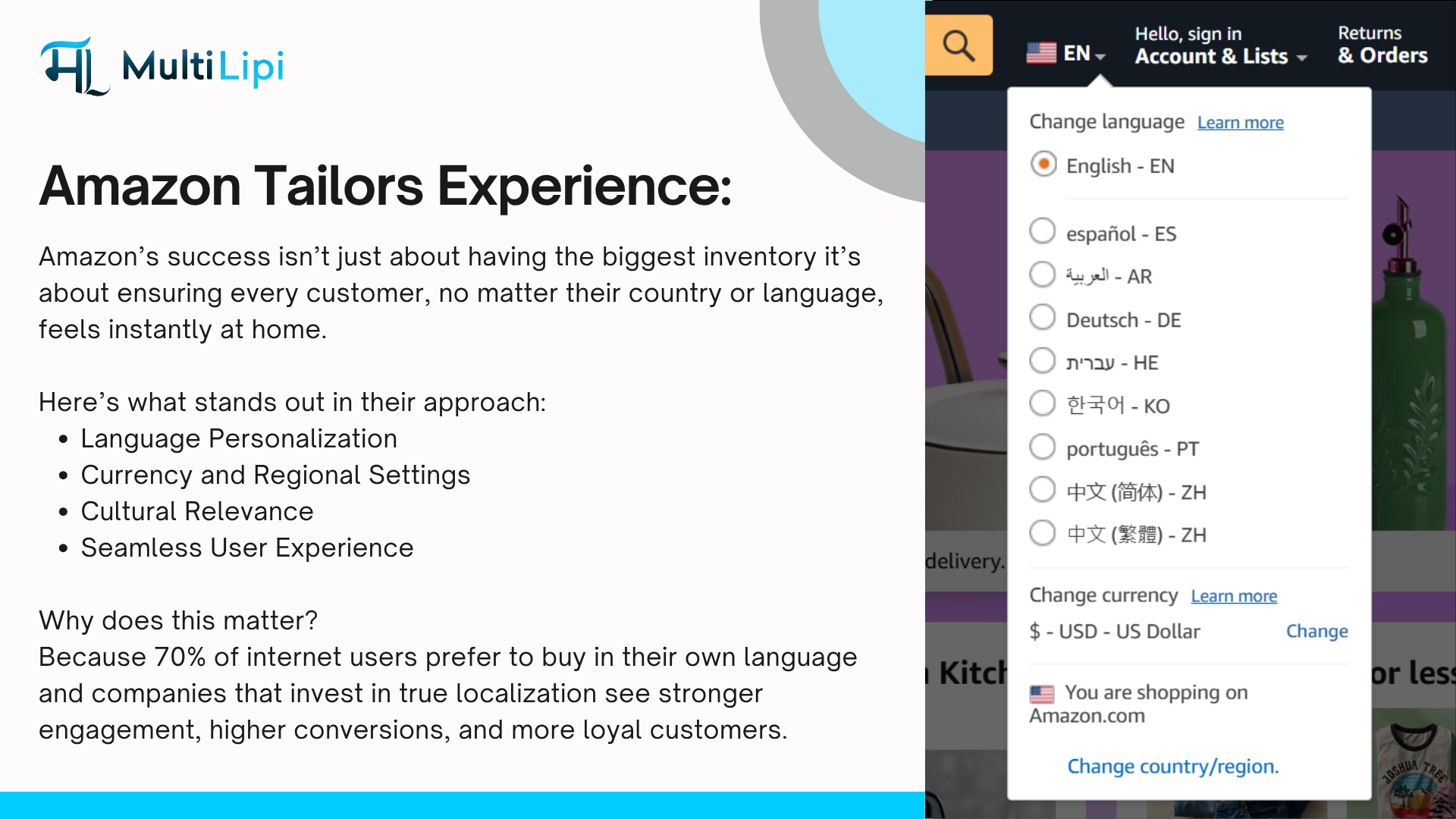
Phase 1: U.S. Roots and Initial International Steps
In its early years, Amazon focused on saturating the U.S. market, establishing itself as a dominant online bookseller before branching out. The first foray into international waters came in 1998, when Amazon launched its first foreign websites in the United Kingdom and Germany (money.cnn.com). This move targeted markets that were geographically and culturally closer to home – the UK shared a common language, and Germany was a major developed market with an appetite for e-commerce. From day one, Amazon localized these sites: the UK site offered a catalog of 1.2 million British book titles, while the German site launched with 335,000 German-language titles to serve local readers. These initial expansions allowed Amazon to test its localization strategy in relatively familiar markets before venturing further afield. By focusing on English-speaking and Western European countries first, Amazon built a foundation it could learn from without straying too far from its comfort zone.
Astuce de localisation : If you’re just starting out with global expansion, target markets that share similarities with your home market (language or cultural) as your testing ground. This lets you refine your localization strategy on a smaller scale avant de se lancer à tapis .
Phase 2 : Accélérer l’expansion mondiale
After solidifying its U.S. presence and gaining experience in the UK and Germany, Amazon made a bold push in the 2000s to diversify into new regions around the world. This expansion phase saw Amazon entering pays non anglophones d’Europe, d’Asie et d’Amérique latine , which required a much deeper commitment to localization. Amazon launched sites in France and Japan in 2000, followed by China, Canada, and others in subsequent years. Each new market brought unique challenges – different languages, consumer behaviors, and competitor landscapes – forcing Amazon to move beyond a one-size-fits-all approach.
During this period, Amazon learned that simply translating its website text n’a pas suffi à séduire les clients étrangers ( accelingo.com). L’entreprise a investi dans une localisation complète : traduction complète des interfaces et des informations sur les produits, embauche d’équipes de langue maternelle et adaptation aux normes et réglementations locales . For example, in Japan, Amazon discovered it needed to emphasize ultra-fast delivery and a wider product selection to compete with local e-commerce favorites. In emerging markets like China and India, Amazon encountered consumers with very different needs and constraints than U.S. shoppers. In India, credit card usage was low, so Amazon introduced a “Paiement à la livraison ", directement catering to a population with limited credit card penetration. In China, where local marketplaces like Alibaba’s Tmall dominated, Amazon initially struggled by trying to impose its U.S. model; the company learned the hard way that “one size fits all” doesn’t apply to international expansion and that it had to adjust to local pricing and payment preferences.
By the end of this phase, Amazon had expanded to dozens of countries and languages – but equally important, it had grasped that true localization means aligning with les nuances culturelles, les comportements des consommateurs locaux et les tendances du marché , pas seulement traduire des mots. Les investissements dans le support client multilingue, les offres de produits spécifiques à chaque pays et les campagnes de marketing local au cours de cette période ont ouvert la voie à la domination d’Amazon sur de nombreux marchés.
Astuce de localisation : Au fur et à mesure que vous vous développez, investissez dans Une localisation complète, pas seulement une traduction directe . Take time to understand each market’s cultural nuances and consumer habits so you can make your product or service truly resonate with local audiences. Amazon’s rise shows that adapting to how people shop and what they value in each country is crucial for global success.
Phase 3 : Approfondissement de la localisation et de la stratégie hyper-locale
Une fois qu’Amazon s’est implanté dans de nombreux pays dans les années 2010, l’accent a été mis sur deepening its market penetration and outpacing local competitors through hyper-local strategies. This phase has been about doubling down on localization and sometimes partnering with local players to strengthen Amazon’s position.
A hallmark of Phase 3 was Amazon’s push into large emerging markets with pronounced local preferences. A prime example is Inde , where Amazon launched in 2013 and quickly realized that to reach the next hundreds of millions of customers, it needed to operate in languages beyond English. In 2018, Amazon added Hindi as a language option on its Indian site and mobile app, aiming to reach the half-billion Hindi speakers in the country (theverge.com). Until then, Amazon.in (like most major e-commerce sites in India) had been English-only, even though only about 10% of Indians speak English fluently. By Traduction de l’interface utilisateur et des informations sur les produits dans la langue locale dominante , Amazon a rendu la plateforme plus accessible – et encore plus fiable – à des millions de nouveaux clients qui se sentaient plus à l’aise pour faire leurs achats en hindi. Suite au succès de l’hindi, Amazon India a déployé la prise en charge de Sept autres langues régionales , y compris le tamoul, le télougou, le kannada et le bengali, de sorte qu’aujourd’hui Amazon India est disponible en Huit langues prononcées par des centaines de millions de personnes ( restofworld.org ). Cette profonde campagne de localisation en Inde a ouvert les vannes à de nouveaux acheteurs : la société rapporte que des millions d’utilisateurs accèdent chaque mois à la plateforme d’Amazon dans les langues indiennes régionales , un témoignage clair d’une demande latente au-delà des anglophones.
Amazon employed a similar hyper-local approach in the Middle East. In 2017, Amazon acquired the Dubai-based e-commerce platform Souq.com, and by 2019 it launched Amazon.ae – its first fully Arabic-language site in the United Arab Emirates (bizon.solutions ). Overnight, UAE customers who had been using Souq could switch to Amazon.ae and shop in Arabic on both the website and app. This move instantly gave Amazon a culturally resonant presence: Amazon.ae carried over 30 million products from Souq (including region-specific items like prayer rugs and popular local snacks for Ramadan) and millions of new products under the Amazon brand. The result? Amazon quickly capturé environ 50 % du marché du commerce électronique des Émirats arabes unis et environ 25 % du marché saoudien , far ahead of the nearest local competitor. By delivering a fully localized Arabic experience – from language to local payment options – Amazon cemented its leadership in a region where it was a newcomer just a few years prior.
Dans certains cas, l’approfondissement de la localisation signifiait également savoir quand partner with local platforms. Nowhere was this more evident than in China. Amazon entered China in the early 2000s by acquiring local online bookstore Joyo, rebranding it as Amazon China, but struggled to compete against Alibaba’s entrenched marketplaces. After years of losses, Amazon made a strategic pivot in 2015: rather than fighting alone, it partnered with Alibaba’s Tmall to set up an Amazon storefront on that platform. This move acknowledged that Alibaba’s local insight and infrastructure were crucial for reaching Chinese consumers. While Amazon eventually wound down its own direct retail in China, this partnership illustrated a key lesson of Phase 3 – sometimes collaborating with local giants or adjusting the business model is necessary to serve a market on local terms.
By the end of this phase, Amazon’s international strategy had evolved into a highly localized playbook: multiple local languages, local payment methods (from India’s mobile wallets to Brazil’s boletos), local customer service teams, region-specific marketing campaigns, and strategic alliances where needed. The company showed it was willing to Faites un effort supplémentaire pour « être local » partout – even as it leveraged its global scale in technology and logistics behind the scenes. This deep localization is a major reason Amazon continues to grow its global user base and fend off local competitors.
Astuce de localisation : Une fois que vous avez pris pied dans un nouveau marché, concentrez-vous sur deepening your connection with the local audience through partnerships and hyper-local offerings. Whether it’s teaming up with local companies, adding region-specific content, or offering tailored services (like local language support and local payment options), these efforts can turn an initial market entry into a sustainable leadership position.
4 choses à apprendre de la stratégie de localisation d’Amazon
Dans les sections qui suivent, nous allons distiller l’approche d’Amazon en quatre leçons clés. Qu’il s’agisse de suivre votre expansion mondiale, de définir le langage ou l’expérience utilisateur, ces informations offrent une feuille de route à toute entreprise cherchant à se développer à l’international.

1. Ne vous précipitez pas – Étendez votre portée mondiale de manière stratégique et progressive
Although Amazon is now synonymous with rapid global growth, it did non conquer the world overnight. A critical lesson from Amazon’s story is to Développez votre expansion mondiale étape par étape instead of trying to do everything at once. Jeff Bezos famously began with a single product category (books) and one country, then methodically added categories and markets once the model proved itself. Likewise, Amazon’s international rollout over the years was deliberate: it started with lower-hanging fruit (the UK, a familiar English-speaking market, and Germany, a large market with an existing online book business Amazon could acquire) before moving into trickier territories. By 2005, Amazon had expanded to a handful of major economies; it waited until it had the operational know-how and customer insights from these expansions before diving into very complex markets like India (launched 2013) or Brazil (launched 2012).
The wisdom of this patient, strategic expansion is evident in Amazon’s successes and even its failures. When Amazon entered Canada and Western Europe early on, it could apply much of its existing playbook (with necessary tweaks) and gain traction quickly. Those early wins built confidence and know-how. In contrast, when Amazon pushed into China aggressively in the 2000s, it struggled – arguably because China’s market was vastly different and Amazon hadn’t yet fully developed its localization prowess. Learning from that, Amazon became more cautious and informed in later expansions. By the time it tackled India, Amazon was prepared to invest billions and several years to adapt the model to local conditions (from fulfillment networks to language localization) rather than expecting instant dominance.
Pour d’autres entreprises, la conclusion est claire : Le rythme compte . Expanding internationally is a complex, resource-intensive process. It’s better to prioritize markets where you have a reasonable shot of understanding customers and complying with regulations, then learn and adjust your strategy for more foreign environments. As Amazon’s journey shows, a phased approach to international growth – where each new market entry builds on lessons from prior ones – can pave the way for long-term global success.
2. Donnez la priorité à la langue (et à la culture)
It sounds obvious, but it’s astonishing how many companies launch globally without fully translating and localizing their content. Amazon’s rise illustrates that La langue est le fondement de la localisation – and a non-negotiable element of global success. From day one of entering a new country, Amazon has made sure its L’expérience client est disponible dans la langue locale , whether that meant German for Amazon.de in 1998 or Japanese for Amazon.co.jp in 2000. The reason is simple: without being fully understandable to your target audience, you stand no chance of succeeding in any international market. Language is the gateway to trust.
Amazon’s aggressive push into multilingual accessibility in recent years underscores this point. In India, as mentioned, Amazon realized it had already tapped out the English-speaking e-commerce segment and needed to Parlez les langues des 500 millions d’internautes suivants . By localizing its app and website into Hindi – and later Tamil, Telugu, Kannada, Malayalam, Marathi, Bengali and more – Amazon showed that it was sérieux sur l’atteinte des clients dans leur langue de confort. L’impact a été immédiat : le lancement en hindi a attiré des utilisateurs qui n’avaient jamais fait d’achats en ligne auparavant. Amazon explicitly noted that translating into the dominant local language makes the site more accessible and semble plus digne de confiance aux clients who might be wary of an all-English interface. In other words, investing in language localization expanded Amazon’s market and enhanced its reputation among locals. Similarly, when Amazon launched in the Middle East via Amazon.ae, it provided Arabic-language navigation and customer support, even retaining a familiar Arabic e-commerce brand (Souq) during the transition period to build credibility. Shoppers are far more likely to use a platform that “speaks” to them — literally and figuratively.
It’s worth noting that language localization goes hand-in-hand with cultural localization. Amazon not only translates text, but also adapts to cultural communication styles. For instance, the tone and wording of Amazon’s customer emails or help pages are adjusted to fit local norms. The company often uses native copywriters and translators rather than literal machine translation for customer-facing content, ensuring the result sounds natural. Small details count too: things like units of measure, date formats, honorifics, and even example addresses are localized on Amazon’s sites. All of this sends a message to users that “we’re built for you, not just copy-pasted from elsewhere.”
La leçon pour les entreprises est claire : Parlez la langue de votre client – literally. Prioritize translating your website, app, product descriptions, and support materials into the local language of each market. Do it professionally and thoroughly, not as an afterthought. And beyond pure language, pay attention to cultural cues in your content. As one industry guide puts it, localization helps you connect with customers in their own language and context, making it an essential component of international success. Even a tech powerhouse like Amazon understood that without linguistic accessibility, their scale and innovations wouldn’t amount to much in foreign markets.
3. Aller au-delà de la traduction : s’adapter aux besoins et aux préférences locales
Bien que le langage soit fondamental, le manuel d’Amazon nous enseigne que La véritable localisation va bien au-delà des mots . To win over customers in different countries, a company must adapt its entire value proposition – product offerings, policies, marketing, and more – to align with local needs and cultural nuances. Amazon excelled at this kind of deeper adaptation (often called “transcreation” in marketing), essentially retooling aspects of its business model for each locale.
L’un des aspects de cette démarche est l’offre Sélections de produits localisées . Amazon learned that it couldn’t just sell the exact same portfolio of goods everywhere – it had to stock items people in each country actually want. In Japan, for example, Amazon expanded categories like electronics and gaming early because Japanese consumers are tech-savvy and those products were in high demand. In India, Amazon added thousands of new sellers and products in categories like fashion, mobile phones, and household goods that matched the preferences of Indian shoppers (including many affordable options and local brands). When Amazon.ae launched in the Middle East, it prominently carried popular regional items (even something as specific as favorite local snacks during Ramadan) alongside its global catalog. By tailoring product offerings, Amazon ensured that new customers weren’t left saying “this site doesn’t have what I need.”
Une autre facette est adapting to local shopping habits and constraints. We discussed how Amazon introduced Cash on Delivery in India – this wasn’t just a nice-to-have feature, it was crucial because a large segment of Indian customers either don’t have credit cards or don’t trust online card payments. By catering to a population with limited credit card penetration through COD, Amazon a supprimé un énorme obstacle à l’achat sur ce marché. De même, Amazon prend en charge d’autres méthodes de paiement localisées : par exemple, proposer le paiement par facture en Allemagne (où le paiement par facture bancaire est courant), accepter les paiements dans les magasins de proximité au Japon et intégrer des portefeuilles mobiles dans des pays comme le Mexique et l’Indonésie. Ces ajustements nécessitent des efforts supplémentaires et une intégration de la part d’Amazon, mais ils améliorent considérablement le taux de conversion et le niveau de confort des acheteurs locaux. En bref, Amazon va à la rencontre des clients là où ils se trouvent.
Additionally, Amazon localizes its Stratégies de marketing et d’engagement des utilisateurs for each region – a true “transcreation” approach. The company doesn’t blast the same ads or site banners globally. Instead, it runs Campagnes ciblées that speak to local culture and events. For instance, Amazon’s advertising in India heavily features local celebrities and references Indian festivals like Diwali, often promoting big “Diwali Sale” events. In France, Amazon tailored marketing around the idea of « La rentrée » (back-to-school season) and the winter holidays. In Brazil, it integrated the massive Black Friday concept but also runs promotions for Carnival season. Even Amazon’s visuals and taglines are adjusted – what works to attract a customer in Germany might be tweaked for Spain or Turkey to be culturally relevant. This is what’s meant by « Campagnes marketing transcréées » : not just translating an English slogan, but reimagining the message to hit home in the target culture.
De manière cruciale, Amazon prête attention à Commentaires et attentes des clients locaux . A concrete example is how Amazon adjusted its return policies and customer service in different countries. German shoppers historically have strong consumer protection laws and high expectations for hassle-free returns – Amazon.de adapted by offering generous return windows and quick refunds, which helped it gain trust (one reason Amazon now contrôle près de la moitié des ventes au détail en ligne en Allemagne ). In Japan, customers value polite, prompt service; Amazon Japan ramped up 24/7 customer support in Japanese and ultra-reliable delivery, which aligned with local service standards. By contrast, in some emerging markets, buyers might be more price-sensitive and willing to tolerate basic service if prices are low – Amazon sometimes emphasizes cost-savings and discounts in those regions accordingly. All these tweaks reflect a mindset of l’empathie culturelle : Amazon studies each market and adjusts its operations to fit local norms and customer priorities.
La leçon principale : Localisez l’ensemble de l’expérience utilisateur, pas seulement le texte . Product-market fit can vary by country, so be ready to modify your offerings. Adapt your payment, pricing, and fulfillment to remove local friction points. And shape your marketing and customer service to align with local culture. As one analysis of Amazon’s strategy put it, “one size fits all” does not apply – Amazon tailors its mix of products, payments, and messaging to each market’s tastes and values. Cette localisation holistique est ce qui sépare les gagnants mondiaux des entreprises qui se développent à l’étranger pour découvrir que personne n’achète.
4. N’oubliez pas l’ensemble de l’expérience client (conception, confiance et support)
Finally, Amazon’s success highlights that localization isn’t just about front-end offerings – it extends to every aspect of the customer experience, including website design, support, and building trust through local presence. In going global, you must not overlook the Détails du « dernier kilomètre » qui rendent votre service vraiment utilisable et crédible pour un client local.
Un détail important est Localisation de l’interface utilisateur et du design . This can mean simple things like translating all menu items and buttons (which Amazon of course does), but also adapting layouts and features to local expectations. For example, Amazon’s site in Japan has a very dense, information-rich layout, which aligns with the style of many Japanese e-commerce sites (Japanese shoppers are accustomed to seeing lots of details and options on one page). In contrast, Amazon’s North American site design might appear a bit more streamlined. Similarly, Amazon India’s app not only appears in local languages now, but also incorporates visual cues and banners for big local shopping events (like Great Indian Festival sales) right on the homepage – essentially designing the user journey around local shopping behavior. While Amazon’s core design language is consistent, these subtle tweaks in each country’s site/app improve user comfort. Research in web localization finds that Les éléments de mise en page et de conception doivent tenir compte des modèles de lecture, de l’imagerie et des normes locales so that users feel at home. Amazon doesn’t radically redesign each site, but it does enough A/B testing and local research to ensure its UI doesn’t inadvertently confuse or alienate users in different markets.
Un autre aspect crucial est Service client dans la langue locale , which Amazon provides universally. It’s not just the website that’s localized – if you email or call Amazon in France, you’ll get help in French; in Brazil, in Portuguese; and so on. This builds trust and solves problems faster. Amazon even localizes its Alexa voice assistant’s language and skills for different countries (Alexa speaks everything from Hindi to Italian now), showing the commitment to a fully localized ecosystem. As one MultiLipi industry insight notes, providing information and support in multiple languages « améliore l’expérience d’achat globale » et aide les clients à se sentir plus connectés à la marque ( multilipi.com ). Les consommateurs sont beaucoup plus confiants lorsqu’ils achètent sur une plateforme qui offre clairement un service après-vente dans leur langue, car ils savent qu’en cas de problème, ils n’auront pas à essayer de traduire leur plainte. Les entreprises qui se développent à l’échelle mondiale doivent s’assurer que leurs centres d’aide, leurs FAQ, leurs chatbots et leur personnel d’assistance sont équipés pour les langues locales et l’étiquette culturelle.
Instaurer la confiance, c’est aussi localizing your brand’s credibility signals. Amazon understood that to win customers in, say, Italy or the UAE, it had to appear as partie de ce paysage commercial local, et non d’un envahisseur étranger. C’est l’une des raisons pour lesquelles Amazon utilise souvent country-specific domain names (Amazon.it, Amazon.ae, Amazon.in, etc.) and hosts sites on local servers – it’s not just functional, it’s psychological. It partners with local delivery services or sets up its own delivery hubs to ensure fast, reliable shipping, which gives customers confidence that Amazon is serious about serving their area. Moreover, Amazon complies with local laws on data privacy, taxes, and consumer rights, which further solidifies trust. In regions with strict regulations (Europe’s GDPR, for instance), Amazon’s compliance shows customers that it respects local rules. Respect des réglementations locales – whether for product safety standards, return policies, or data protection – isn’t just about avoiding legal trouble, it’s about demonstrating respect for the local consumer. Shoppers are savvy; they know when a company is skirting the rules or treating their market as second-tier. Amazon’s scale means it often sets new standards in the markets it enters (like raising the bar for fast shipping or customer protection), which in turn raises customer expectations of all e-commerce players.
Enfin, Amazon tire parti Avis locaux et preuve sociale , which are an often overlooked part of localization. A product on Amazon’s global catalog might have thousands of reviews in English, but a French customer might trust a handful of French-language reviews more. Amazon facilitates this by displaying reviews written in the shopper’s preferred language at the top, and even uses machine translation for foreign reviews in some cases to increase their utility. By doing so, Amazon again speaks to customers in their language même dans le contenu généré par l’utilisateur . This strategy underscores a key point: every touchpoint, from browsing to checkout to after-sales, should be as localized as possible to craft a seamless experience. The easier and more familiar you make it for customers, the more likely they are to buy – and remain loyal.
En résumé, N’oubliez pas les détails qui créent une expérience client véritablement locale . This includes localized design/UI, customer support, payment and delivery methods, compliance, and community features. Amazon’s example shows that removing quelconque Les frictions (linguistiques, logistiques ou émotionnelles) pour les utilisateurs locaux rapportent des dividendes. À la suite de ces efforts, les entreprises peuvent considérablement Améliorez l’engagement et la satisfaction des clients – conduisant à une conversion plus élevée et à des affaires répétées multilipi.com . It’s this end-to-end attention to local experience that turns a translated website into a beloved local shopping destination.
Votre modèle pour le succès mondial du commerce électronique
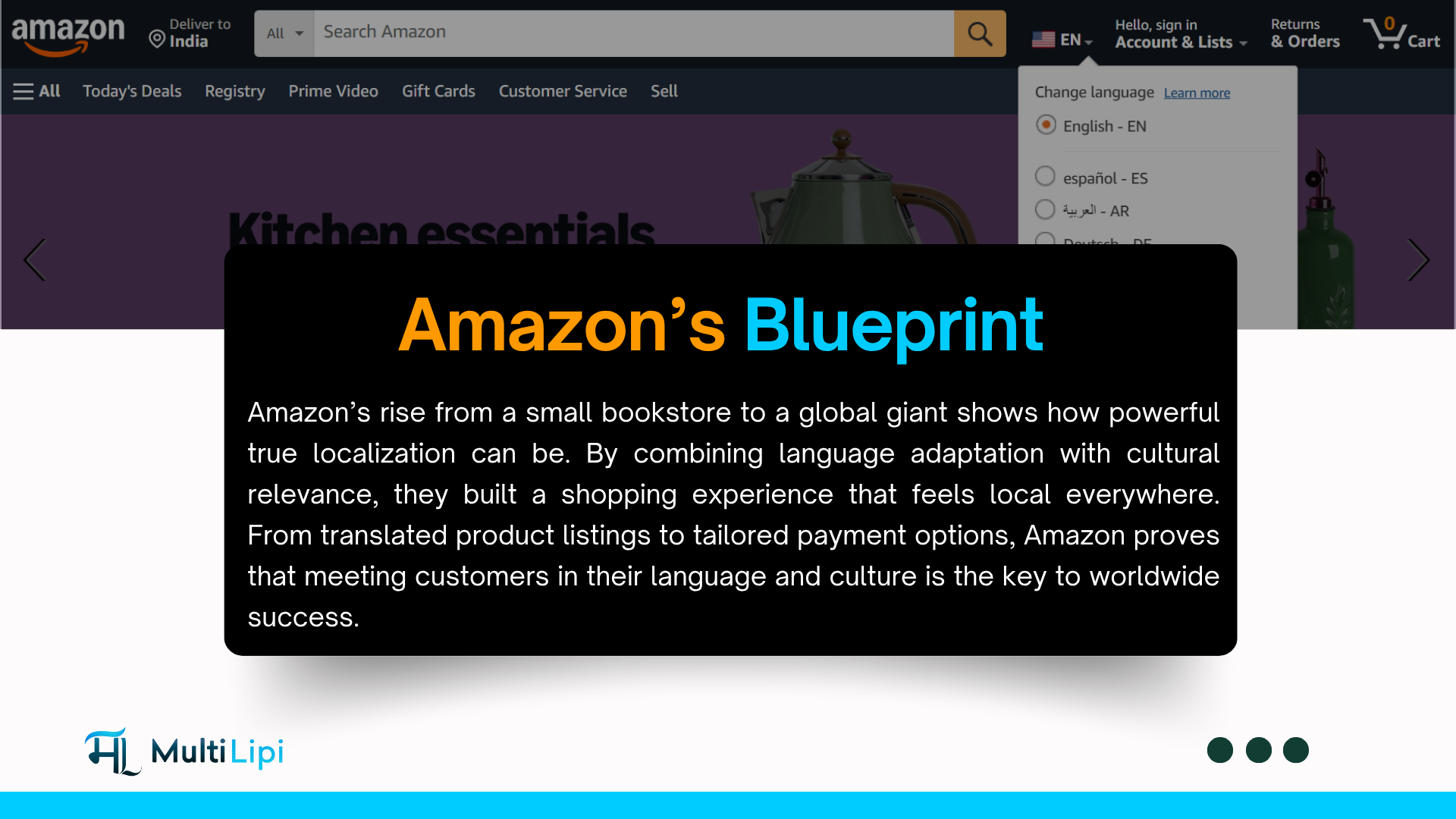
Comme nous l’avons vu, la localisation, en particulier language localization coupled with cultural adaptation – is a major contributor to the global success of companies like Amazon. Expanding into new markets is about more than just making your website readable in another language; it’s about rendre l’ensemble de votre offre culturellement pertinente et accessible to your target customers. Amazon’s journey from a Seattle-based bookstore to a worldwide e-commerce empire provides a masterclass in how to do this at scale. It identified the right markets, took a phased approach, and relentlessly fine-tuned its platform for each locale – from translating millions of product listings to tweaking its business model around local customs.
Quelle que soit la taille ou le secteur d’activité de votre entreprise, la leçon de base est universelle : Rencontrez vos clients là où ils se trouvent . That means speaking their language, respecting their culture, and easing their specific pain points. It could be as straightforward as translating your product descriptions and user interface, or as involved as rethinking your payment options and marketing strategy for each country. The reward for getting it right is a vastly expanded audience and the chance to compete on a global stage.
In fact, businesses that invest in quality localization see clear benefits: wider reach, improved user experience, and even SEO gains from multilingual content (multilipi.com ). En optimisant le contenu pour différentes langues et paramètres régionaux, vous enhance your brand’s global visibility and drive more traffic and sales. Peut-être plus important encore, vous construisez bonne volonté et confiance among international customers, who feel valued when a brand communicates with them in their native tongue. Companies like Amazon, eBay, and others have expanded their global presence by ensuring high-quality, on-brand translations and localized practices – a strategy that any aspiring global business would be wise to emulate.
As you craft your own blueprint for global growth, remember Amazon’s localization strategy as a guiding light. Start with a smart expansion plan, prioritize language and culture, adapt your offerings boldly, and sweat the customer experience details. International success is rarely instant, but with a deep commitment to localization, you’ll be laying the groundwork for your brand to thrive in markets all around the world. In the age of globalization, Passer au local est souvent la clé pour conquérir le monde. Acceptez ce paradoxe et vous serez sur la bonne voie pour décoder votre propre réussite mondiale. Essayez MultiLipi chez multilipi.com

Commentaires